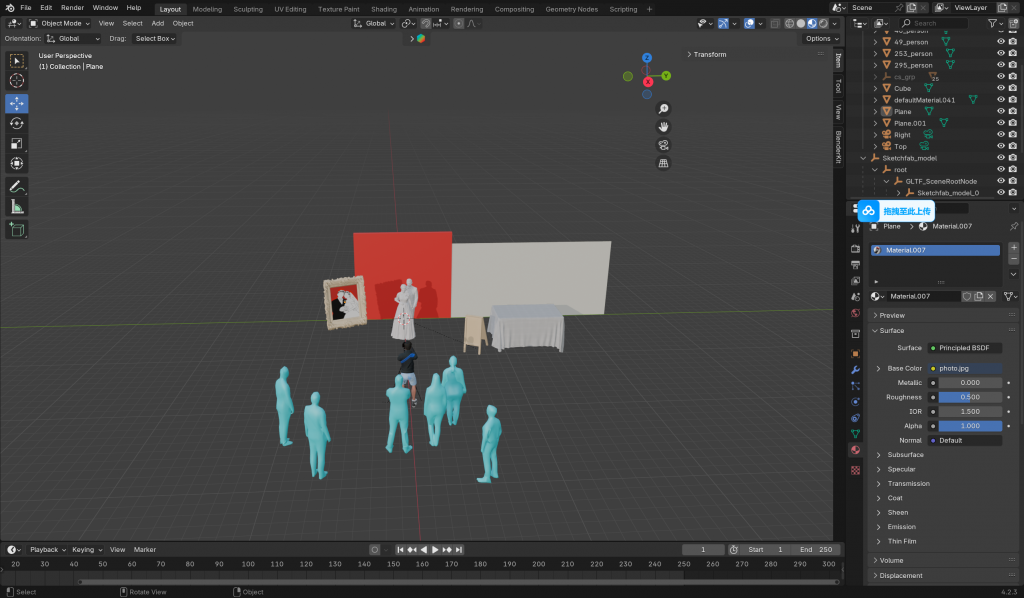
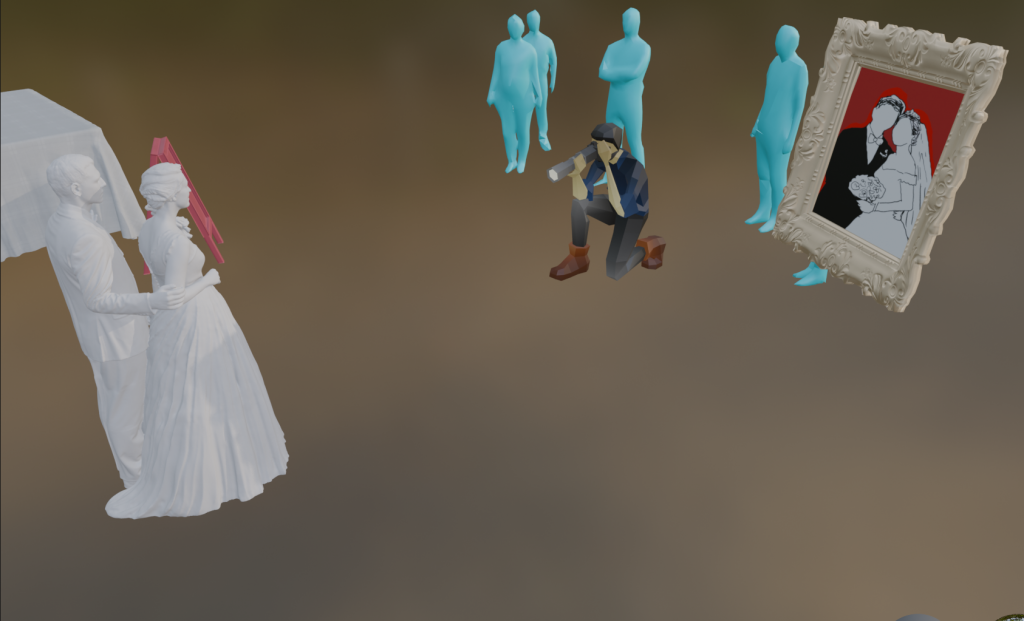
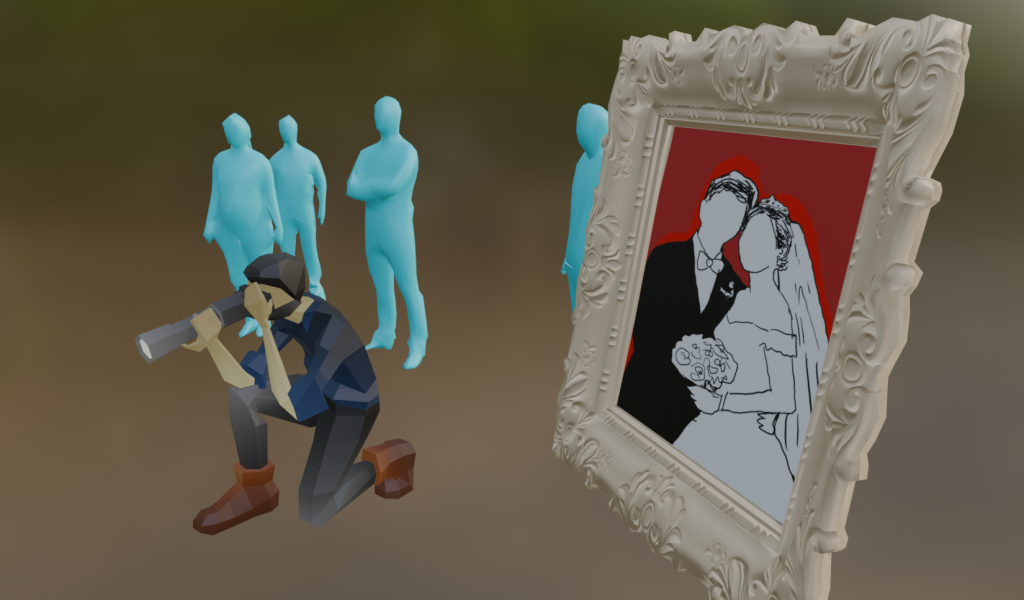
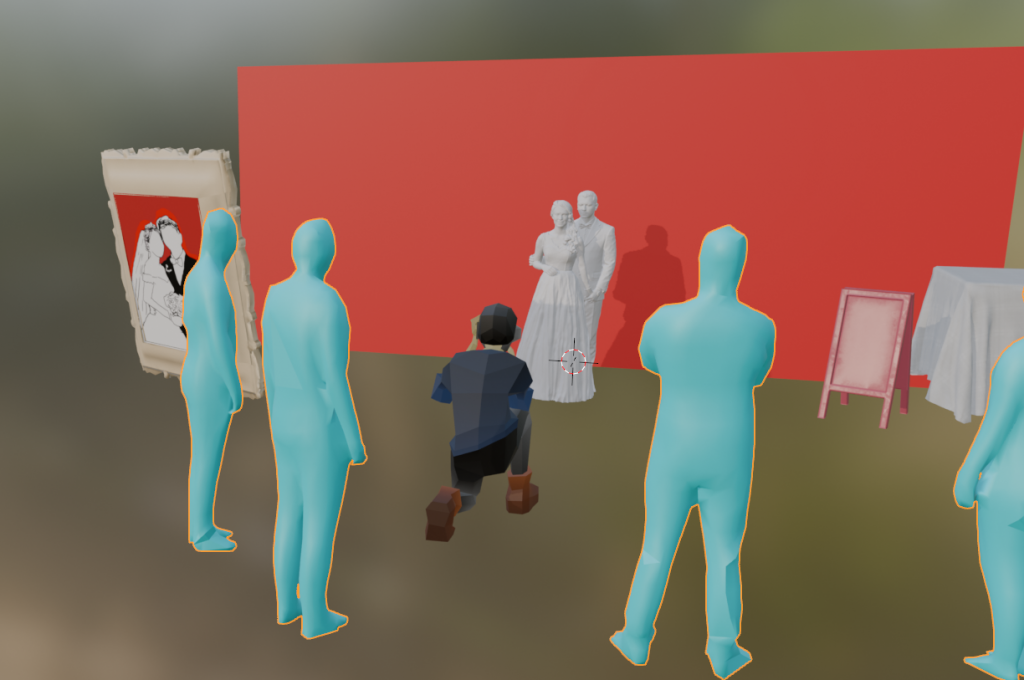
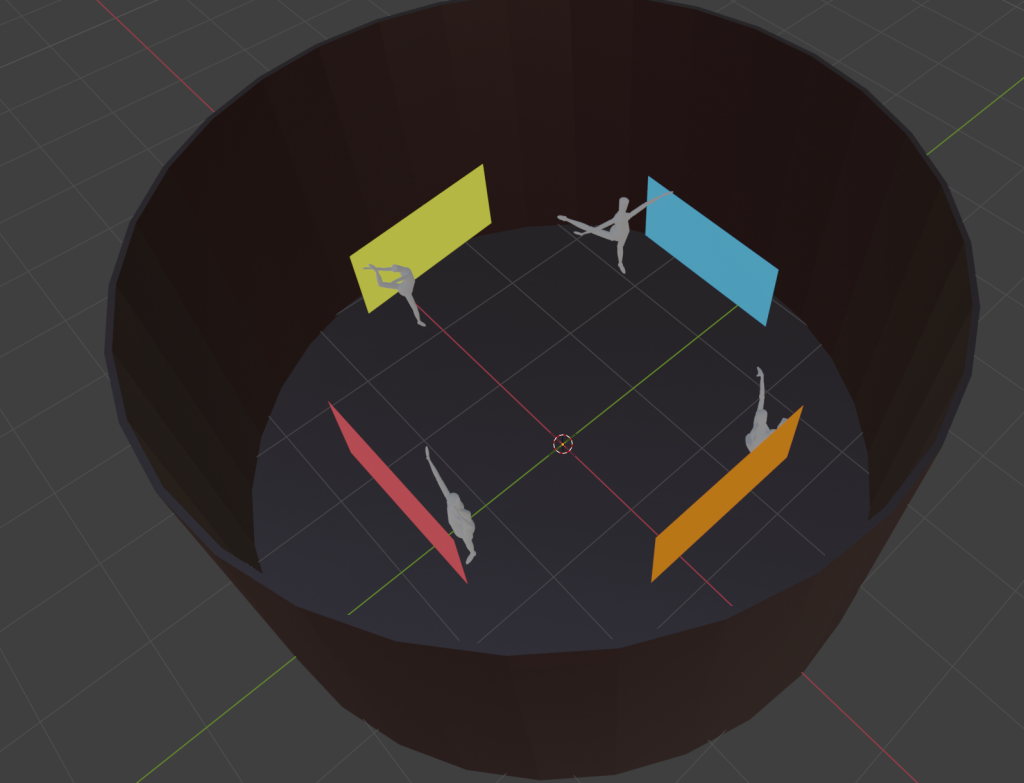
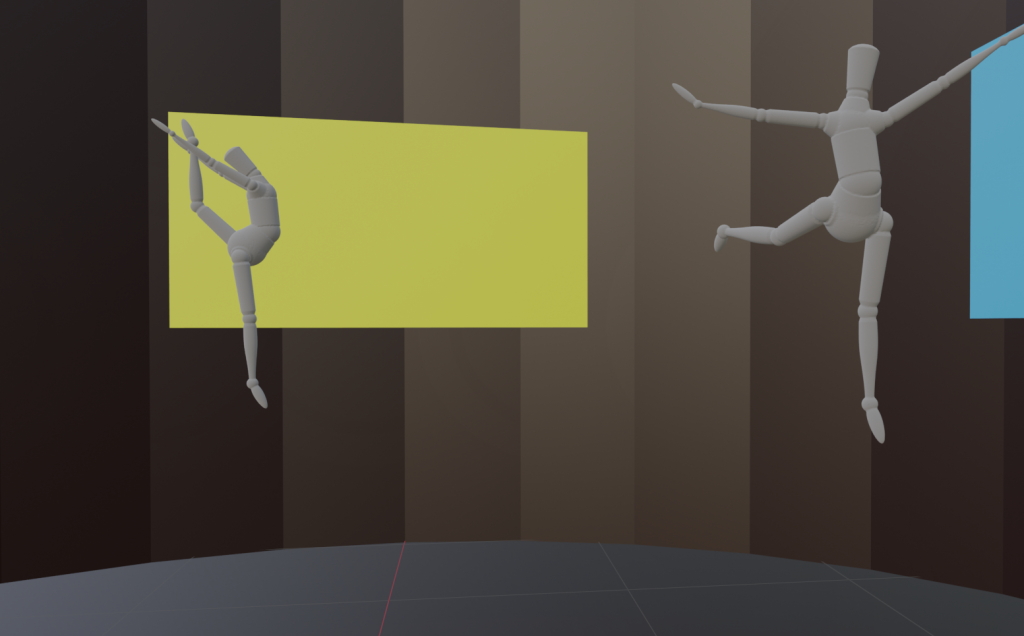
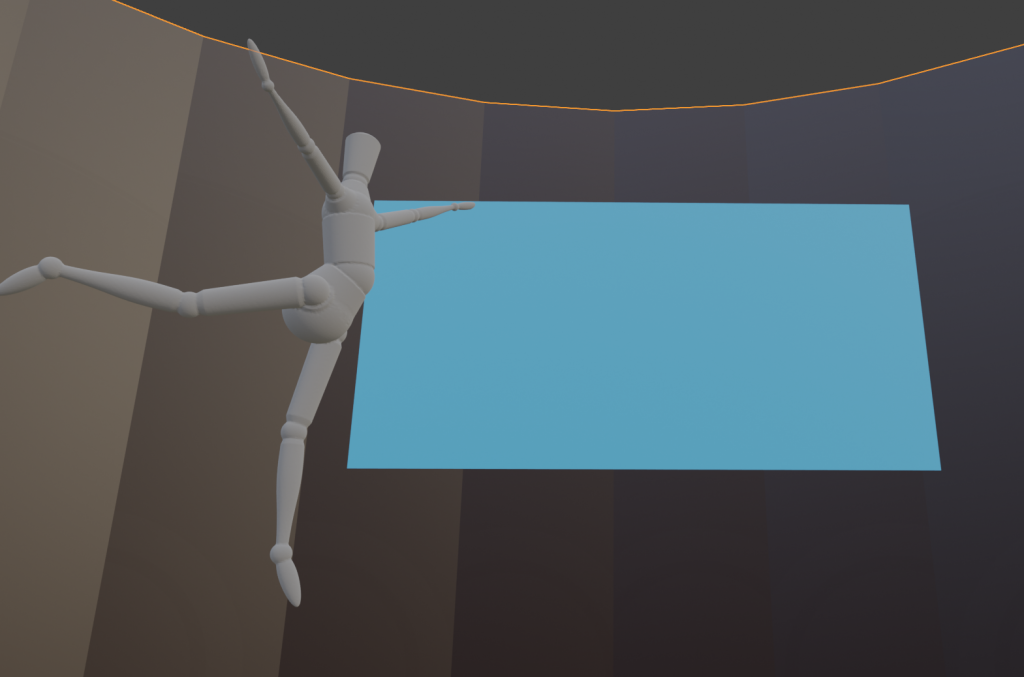
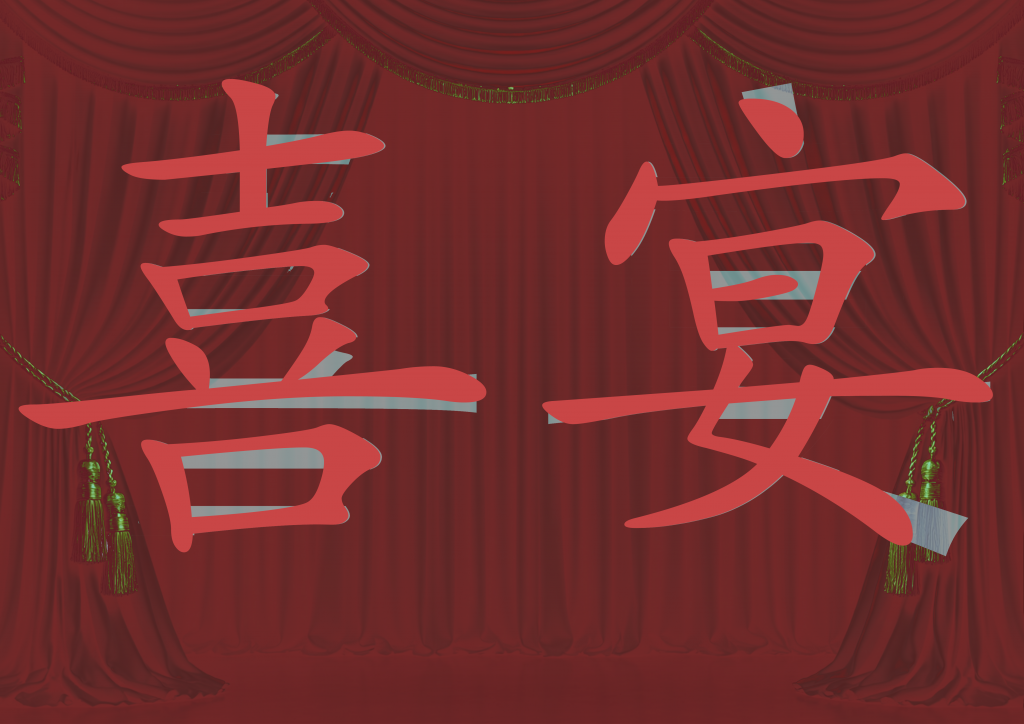
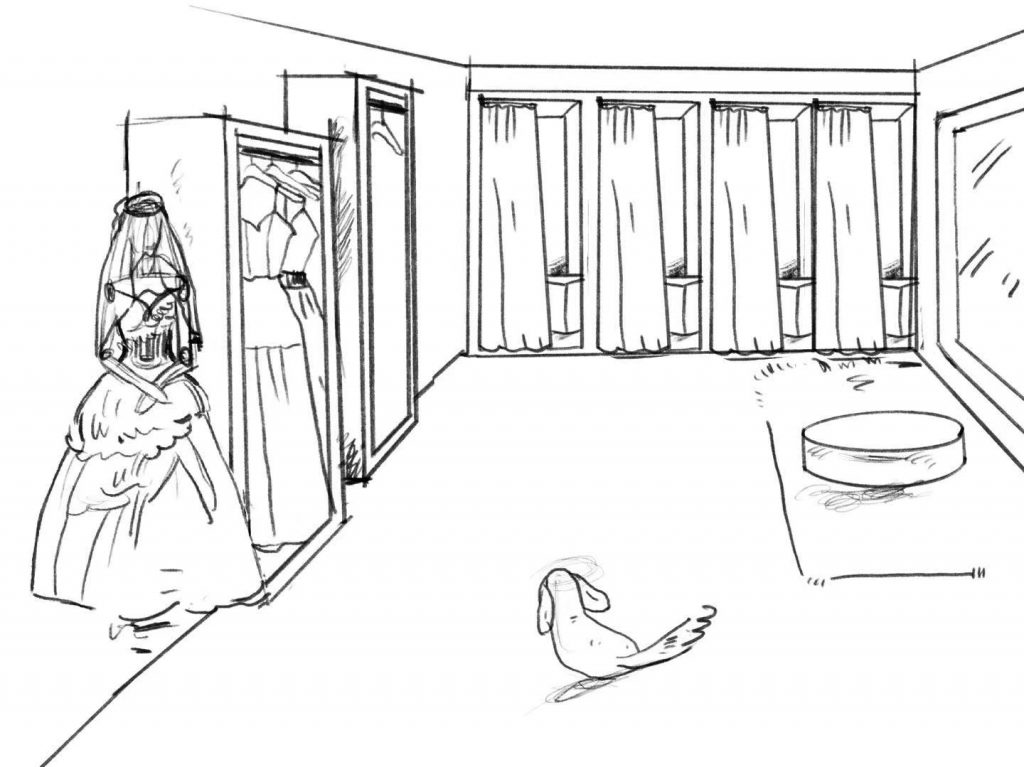
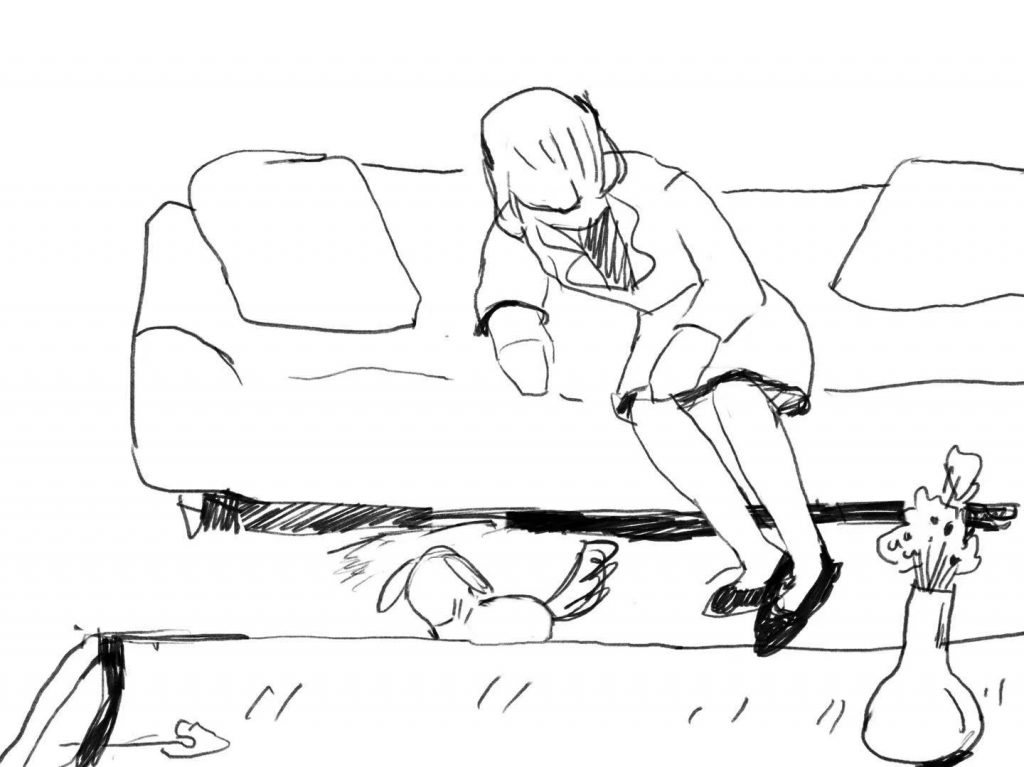
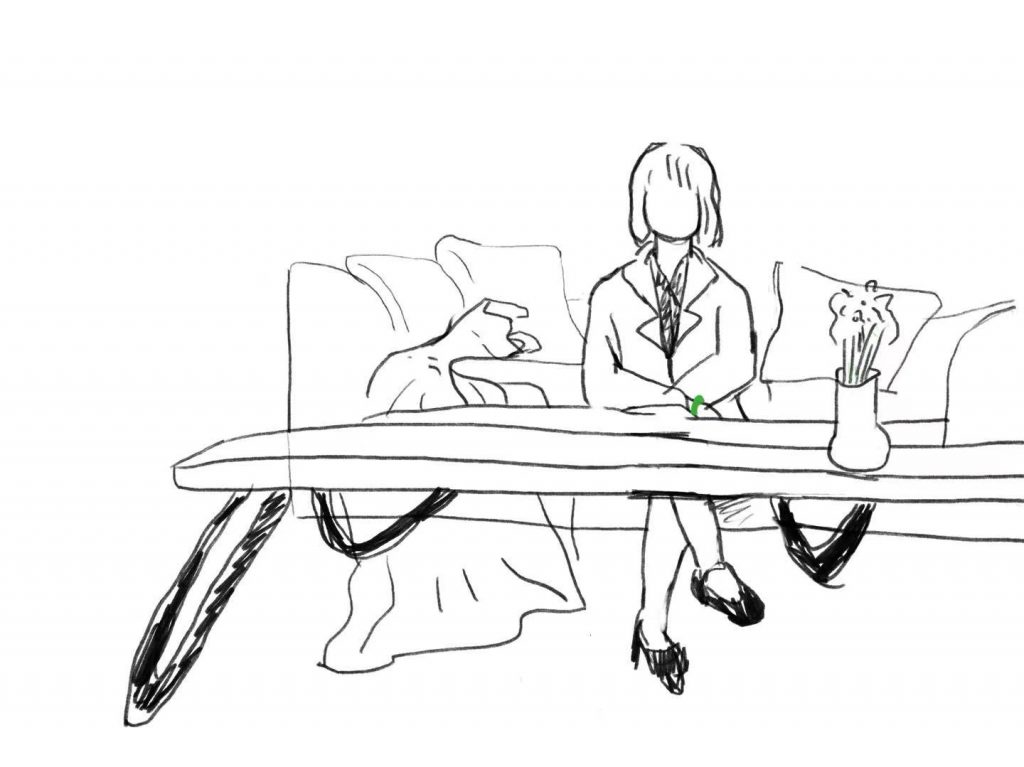
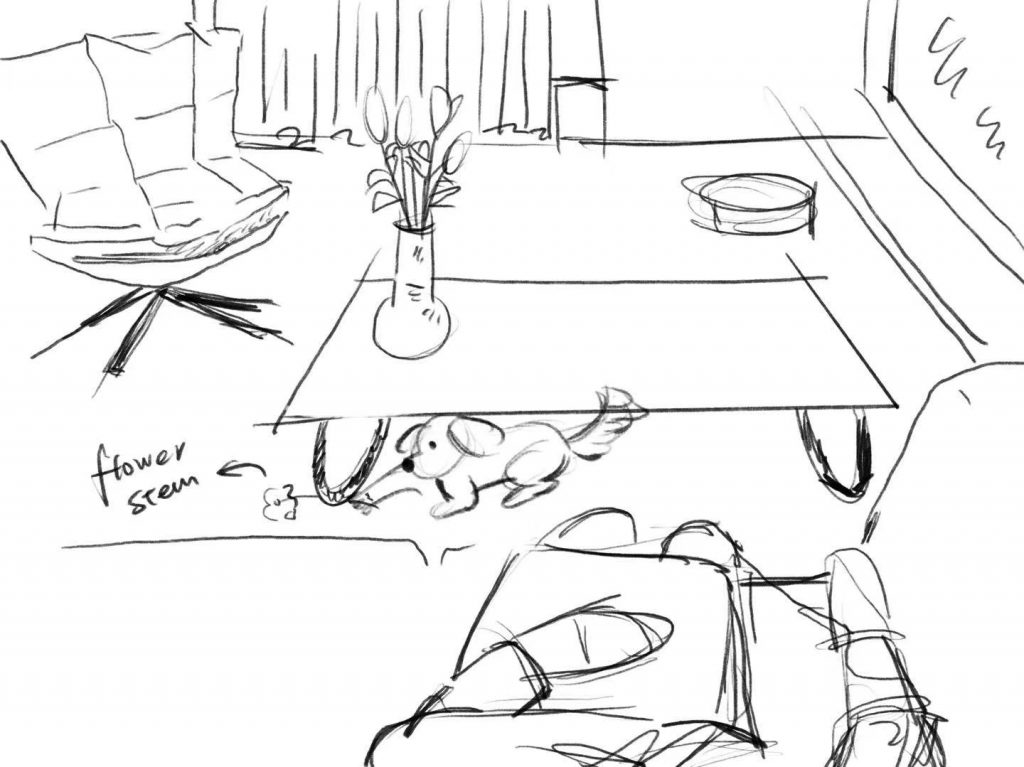
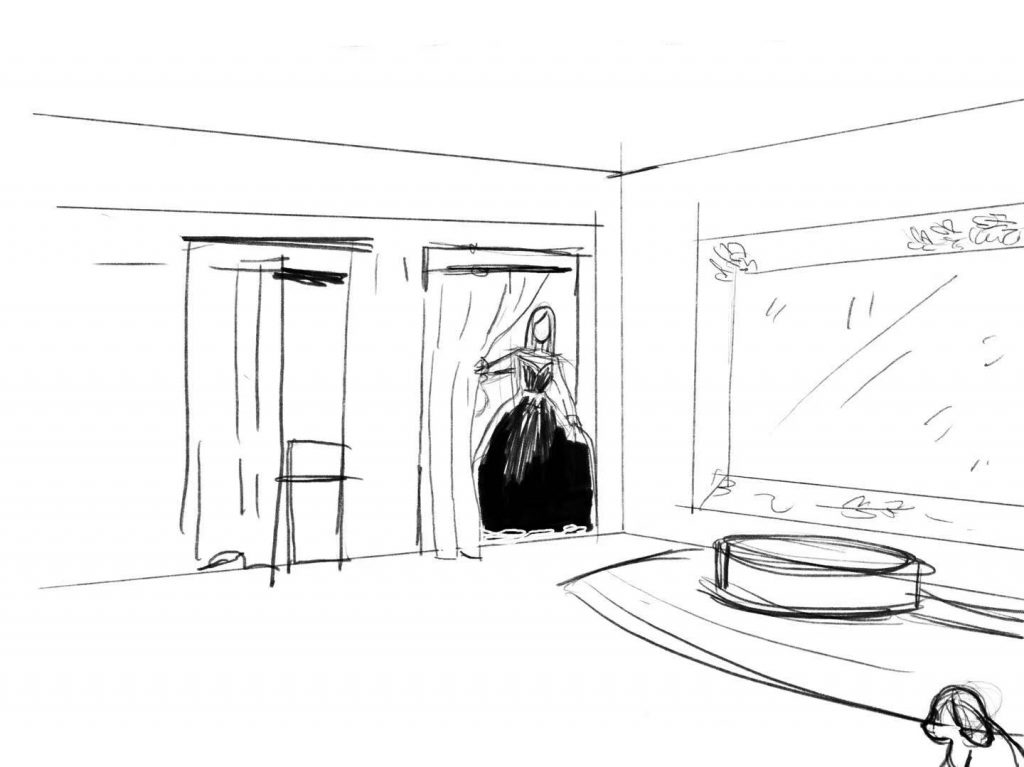
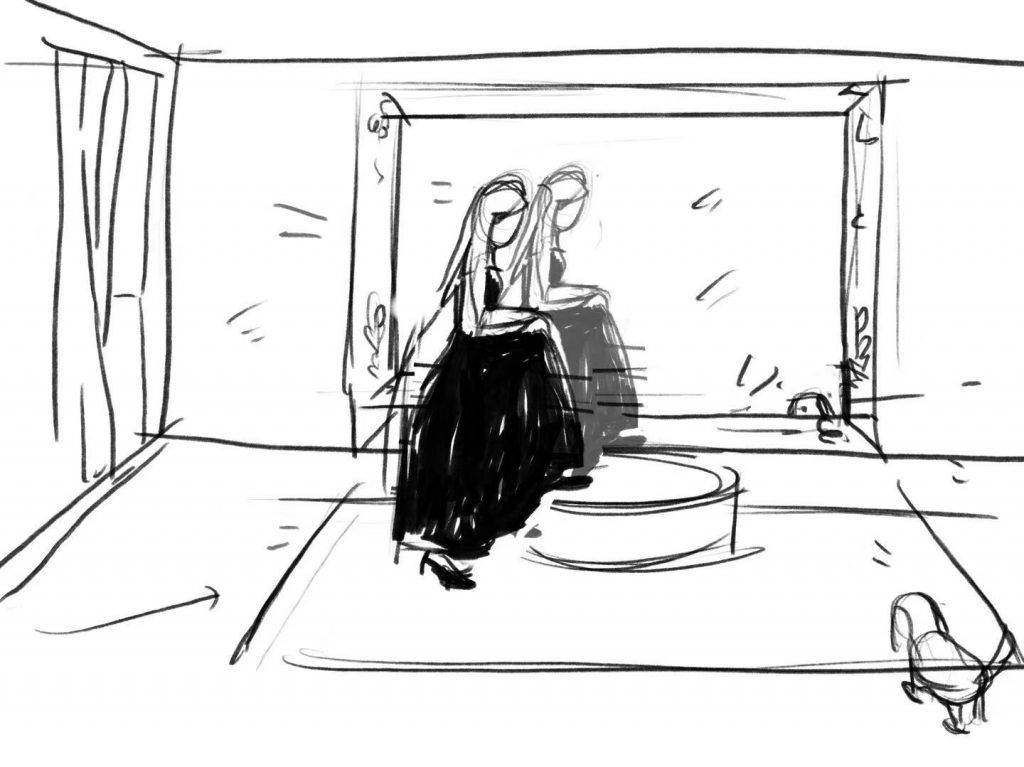
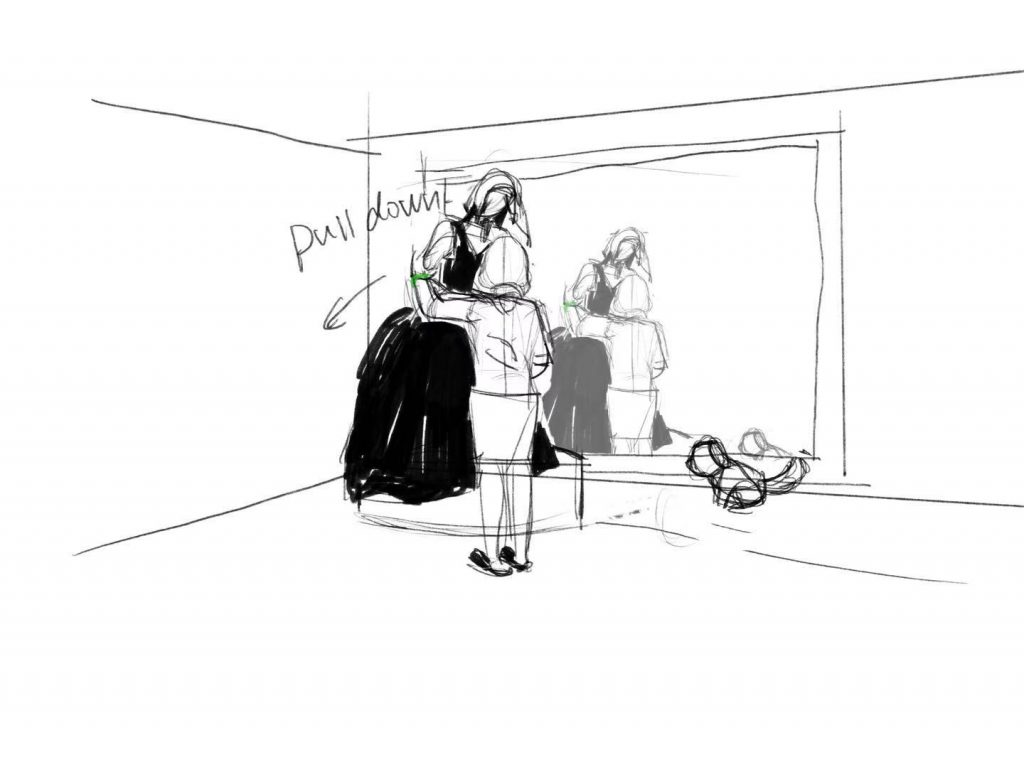
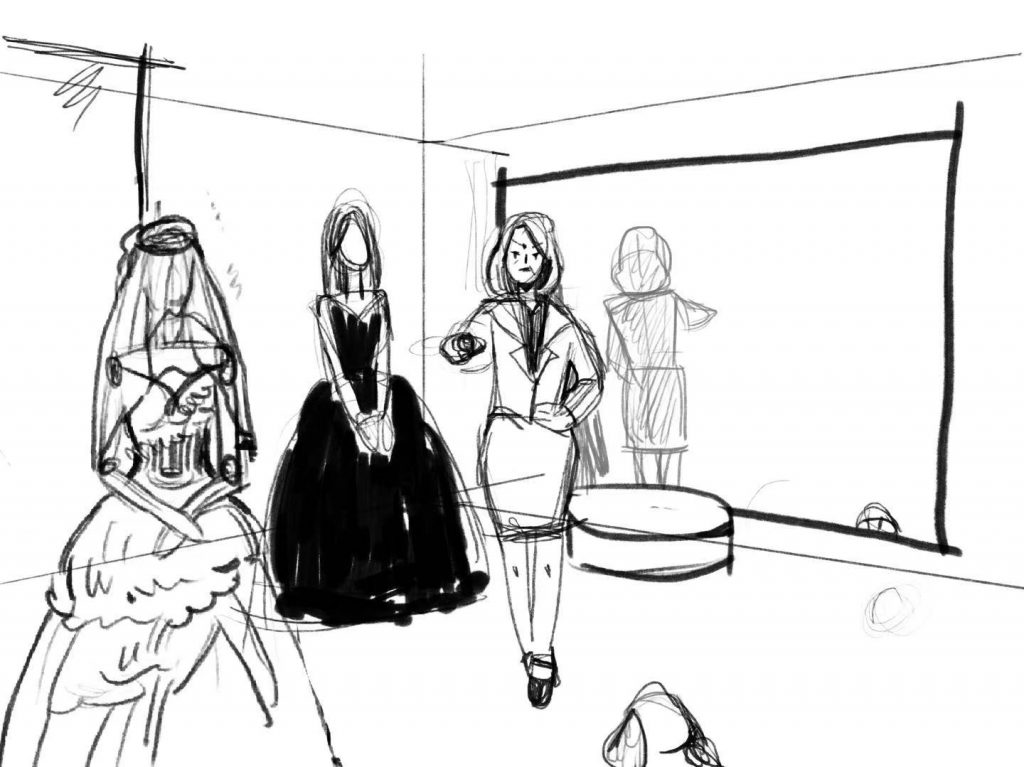
We worked collaboratively by dividing the scenes, with each person responsible for a few specific sections of the story.
I am mainly responsible for designing the opening scene.
At this stage, we focused on making the script clearer and easier to read and experience.
On one hand, we reorganised how information is presented in the script, reducing moments where the story is explained directly through dialogue. Instead, we aimed to let actions, visuals, and spatial changes communicate meaning more naturally.
On the other hand, we put a lot of emphasis on reworking transitions. Compared to earlier drafts with more straightforward cuts, this version experiments with richer transitions, such as using close-ups to carry emotional shifts or having the little girl carry the dog from the reception area into the wedding hall. These changes help the flow between scenes feel more continuous and better suited to VR.
We also revisited the montage sequence, refining its pacing and structure so that the build-up of conflict feels clearer and more coherent.
This week, we mainly responded to the tutor’s feedback by clarifying the overall logic of the script, especially in terms of character roles and transitions.
First, we defined Han Han’s role more clearly. She is no longer just accompanying the dog, but actively guides the player. Through her actions and small self-talk moments, the player can better understand what to pay attention to next, such as noticing the black wedding dress and knowing when to interact. This directly addresses the question of how the player is guided to retrieve the dress.
We also adjusted our transitions. For example, in the balloon room scene, the discovery now belongs to the dog (the player), rather than being triggered by Han Han, which helps strengthen the player’s sense of presence.
we continued pushing the script forward and focused on how to clearly present the conflict within the story. We decided to use montage to show the build-up of tension, allowing different moments of disagreement during the wedding preparation to appear in a compressed and emotional way rather than as isolated scenes.
A major focus this week was refining the role of the dog and its interaction within the narrative. We tried to clearly define the dog’s actions and perspective, using its movement, attention, and physical interaction to help drive the story forward. By doing this, we were able to further develop the plot while keeping the user’s experience grounded in the dog’s point of view.
One important decision we made was to remove the subplot involving a “bad relative.” Instead, we chose to concentrate the conflict entirely on the relationship between the mother and the daughter. This helped make the emotional focus of the story clearer and more direct.
In the climax of the story, the conflict escalates into a more intense argument. Up until this point, the daughter has mostly been obedient and restrained in front of her mother. It is only at this moment that she finally begins to express her true feelings. This shift became a key moment for us, as it marked the turning point in their relationship and set up the possibility for change and reconciliation.
Yi Yi: A One and a Two
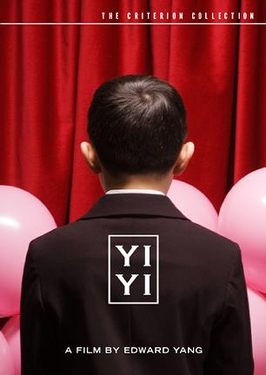
Yi Yi (Chinese: 一一; pinyin: Yī Yī; lit. ‘one one’; subtitled A One and a Two) is a 2000 Taiwanese drama film written and directed by Edward Yang. It centers on the struggles of an engineer, NJ (played by Wu Nien-jen), and three generations of his middle-class Taiwanese family in Taipei.
This week I watched YiYi,The film doesn’t have many elements that can inspire our script, but it left a strong impression on me in other ways.
But One thing I found especially interesting was the way the child character is written. He behaves like a “little adult,” and many of the reflective or philosophical lines in the film are spoken through him. This made the child feel less like a background character and more like an observer who quietly comments on the world around him.
This week, our main focus was on how the conflict between the bride and her mother should happen in the story, and what their reconciliation might look like. We spent a lot of time discussing the overall development of the narrative, especially how tension gradually builds as the wedding progresses, and how it eventually leads to a moment of reconciliation at the end.
we tried to find inspiration from films.One reference we discussed was a film that also revolves around a wedding and a Chinese family, where the central conflict comes from staging a fake wedding in order to meet the parents’ expectations. Throughout this process, the characters’ personal lives begin to change in unexpected ways because of the wedding itself.
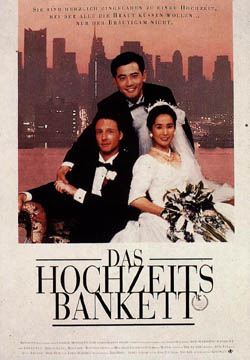
The Wedding Banquet(1993)
The Wedding Banquet[3] is a 1993 romantic comedy film directed, produced and co-written by Ang Lee. The story concerns a gay Taiwanese immigrant man (Winston Chao, in his film debut) who marries a mainland Chinese woman (May Chin) to placate his parents (Gua Ah-leh and Lung Sihung) and get her a green card. His plan backfires when his parents arrive in the United States to plan his wedding banquet and he has to hide the truth of his gay partner (Mitchell Lichtenstein). It was a co-production of Lee’s Good Machine production company, and the Taiwanese Central Motion Picture Corporation.
This reference made us think about a similar question in our own story: whether a wedding is something done for oneself, or something done to give an explanation or reassurance to everyone else. Within the wedding, the conflict between the mother and the daughter emerges from this tension. The mother wants to give her daughter a “perfect” wedding, but this idea of perfection is shaped by social expectations rather than what the daughter truly wants.
This week, we finally decided to fix the user’s perspective as the dog. During our discussions, we realised that using multiple human perspectives would make the story much more complicated, and it would be difficult to clearly tell the story we want. At the same time, if we tried to fully show the wedding process itself, there would be many practical and narrative issues, and we didn’t yet have a clear solution for that.
Because of this, we decided to focus the experience around the dog’s point of view. This felt like a clearer and more manageable direction. The dog works well as both an observer and a participant, allowing the player to move through the wedding, stay close to different characters, and experience emotional moments without needing to directly control the situation.
We also felt that the dog’s perspective opens up many interesting possibilities for interaction. Instead of complex actions, the interaction can focus on movement, proximity, and attention, which feels more natural in VR. Finally, we plan to use a mirror to reveal the dog’s true identity at the end of the experience. This moment works as a gradual narrative reveal, where the story slowly becomes clear rather than being explained all at once.
This week, we continued developing our XR story idea and tried to clarify what the story is really about.
We began talking about the idea of using a dog as a central symbol in the story. The dog comes from the daughter’s childhood and represents love, protection, and emotional attachment between the mother and the daughter. Although everyone knows the dog is not real, the family treats it as if it were, which gives the story a slightly surreal tone.
We also discussed the importance of using different perspectives in the story. Instead of telling the story from a single point of view, we want it to unfold gradually through theswitching between different characters. The idea is that the story stays in one event, but the meaning slowly changes depending on who you are and where you stand.
One reference we mentioned was the game Subway Bloom by Rusty Lake. In the game, everything happens on a train, and each station represents a different stage of the girl growing up. You see her change from a baby held by her mother to an adult. As a player, you mostly watch this process from the side, but you can still feel the mother’s love through small moments that happen as the girl gets older.
It can be shown through time passing and through what you see when you move between different perspectives. That’s something we want to try in our own story as well.